
Saguache County Court Record Requests
The Clerk of Court at Saguache Combined Court keeps the files for both Saguache County Court and Saguache County District Court. Brandie Taylor is the listed Clerk of Court. Don't confuse her office with the separately elected county Clerk and Recorder, which handles elections, land recording, and motor-vehicle records rather than judicial case files.
You can reach the clerk several ways. File the Record/Document Request Form online, email SaguacheClerk@judicial.state.co.us, or call 719-655-2522. Walk-in service is at 501 4th Street, and mail goes to P.O. Box 197, Saguache, CO 81149. The counter is open weekdays from 8:00 a.m. to 4:00 p.m. State holidays are excluded. Fax ordering, a drop box, and a public terminal are not listed options. Call before counting on them.
- Identify the court, case number, year, case type, and parties as fully as possible.
- Select the ROA or the exact filed documents needed rather than requesting an undefined full file.
- Mark whether a certified or exemplified copy is required.
- Submit through the webform, email, mail, phone-assisted route, or counter.
- Review the clerk's quote, access conditions, and delivery instructions before paying.
Inside Saguache's Record Webform
The webform gathers a few things first. Contact details, case identifiers, and the documents you want. First and last name, email, phone, address, and party information are required fields. A case number, case type, filing year, birth date, or other identifying facts help the clerk tell similar matters apart. A county selector routes the request to Saguache.
| Form group | Examples | Why it matters |
|---|---|---|
| Case identity | Number, type, year, location | Reduces name-search work and delay |
| Family documents | Decree, parenting plan, support order | Names the filed paper instead of the index |
| Criminal documents | Complaint, sentence order, ticket | Separates allegations from final outcome |
| Civil documents | Judgment, satisfaction, protection order | Targets the right clerk product |
| ROA and certification | Register checkbox, authentication checkbox | Requests chronology or official copy status |
Expect a response within three business days unless extenuating circumstances apply. That target is not a promise for an off-site, old, large, or redaction-heavy file.
The form's filing-year choices run back to 1873. Its case-type menu covers civil, criminal, family, juvenile, probate, protection-order, small-claims, traffic, and water matters. Use the Other Documents field when no checkbox fits your paper. Checking Register of Action asks for the chronology. Checking certified or exemplified asks the clerk to authenticate the copy. Either choice still respects restrictions imposed by statute, directive, local order, or a case-specific order. Selecting them does not unlock sealed material.
Kinds of Court Records
Four products get confused constantly. The docket is the future-hearing calendar. The ROA is the chronological case summary. A filed document is the actual complaint, motion, order, or judgment. A certified or exemplified copy is the clerk-authenticated version of any of these. Naming the right product saves real money.
Criminal requests include a Complaint/Information, Disposition/Sentence Order, Protection Order, Ticket, and ROA. Civil requests include an Order for Judgment, Transcript of Judgment, Satisfaction of Judgment, and Protection Order. Family and probate forms carry their own listed papers. Anything unlisted goes in the Other Documents field.
A proceeding transcript is different again. It reproduces spoken court events through the transcript policy and the JDF 4 route. It is not the clerk's Transcript of Judgment.
The difference bites during a judgment search. An Order for Judgment records the court's civil decision. A Transcript of Judgment is a $25 clerk document. It states the judgment in formal record form. A proceeding transcript, meanwhile, comes from the spoken event under the 12th District transcript process. Court-reporter notes themselves fall outside the CJD definition of a court record, though the transcript ordered through the proper channel becomes the formal product.
Four Saguache Record Layers
Each access layer answers a different question. A quick comparison keeps a request focused.
| Layer | Answers | Official source |
|---|---|---|
| Calendar | When and where is court? | Free Judicial Docket Search |
| ROA | What entries and minute orders exist? | Clerk request; vendor view is not official |
| Filed paper | What does the complaint, order, or judgment say? | Saguache clerk |
| Certified copy | Is this clerk-authenticated? | Saguache clerk with certification fee |
CoCourts sells real-time register information. It carries no filed-document images, and Colorado Courts E-Filing serves attorneys and authorized filers rather than the general public.
Court Records: What They Contain
An ROA opens with basics. Case number, class, court, filing facts, caption, and status come first. From there it can identify parties and counsel. It can list filings and minute orders in time order, record settings, and show disposition or post-judgment events. The request form itself confirms that an ROA may summarize charges, sentences, and minute orders. Not every remote view exposes every field.
| Case identity | Year, class, sequence, court, caption, and status. |
|---|---|
| Parties and counsel | Public roles and attorney information where available. |
| Chronology | Filed items and minute orders in date order. |
| Settings | Hearings and their procedural labels. |
| Outcome | Disposition, sentence, judgment, or later activity when public. |
| Documents | Separate filings ordered by exact title from the clerk. |
Need the number first? Run the Saguache County docket search, then carry the full case number straight into the record request.
Off-Site Saguache Court Files
Older records may sit in off-site storage. They come back at actual cost. The county's 1881 courthouse burned in 1910, so an early run can have gaps too. Historical researchers should ask both the clerk and Colorado State Archives about finding aids. Don't assume everything survived in digital form.
Give the clerk a year, a case class, party names, and any other known facts. A broad name search can cost up to the published limit. A complete case number saves staff time. Also note that the three-business-day response target may not stretch far enough. Archival retrieval or heavy redaction can take longer.
Practical point: an empty online search does not rule out an older Saguache County court record stored away from the courthouse.
Say what you actually want when requesting an old file. Is it an index, one filed paper, or an authenticated copy? The clerk may bill actual retrieval cost. Research or redaction time beyond the first free hour can be billed as well. Broad wording forces staff to inspect many pages. A filing year and case class narrow the job fast. If a historic local run is incomplete, a State Archives finding aid can show what survived and where it lives. The archive cannot replace a current Saguache court certification.
Copy Fees and Certification
Saguache County copy charges trace back to Chief Justice Directive 06-01 and the official request forms. Ask the clerk for a quote first, since page count, your status, retrieval work, postage, and redaction all move the total.
| Item | Published amount |
|---|---|
| Electronic or coin copy | $0.25 per page |
| Paper court copy | $0.75 per page |
| Nonparty name search including ROA | Up to $5 |
| Transcript of Judgment | $25 |
| Certificate of Satisfaction | $20 |
| Certified or exemplified copy | $20 per document plus copy cost |
| Off-site retrieval | Actual cost |
| Research or redaction | $30 per hour after the first hour |
Under the published schedule, a party or attorney pays no more than $15 for copies in their own case. That cap leaves nonparties out. Waivers can still apply under the directive or C.R.S. section 13-32-104.
Postage runs by page band. It is $1 for 1 to 17 pages. Then $2 for 18 to 34, $3 for 35 to 59, $4 for 60 to 79, $7 for 80 to 150, and $19 for 151 to 1,200 pages, subject to postal changes. The webform names no single payment method. So wait for the clerk to state the charge and how to pay before mailing funds. A tight request for named documents cuts the page count and makes any estimate far more useful.
CJD 05-01 and Saguache Access
The Chief Justice Directive 05-01 page holds the materials that govern Colorado court-record access. It separates public access from remote access. It also flags records excluded by law, rule, or order.
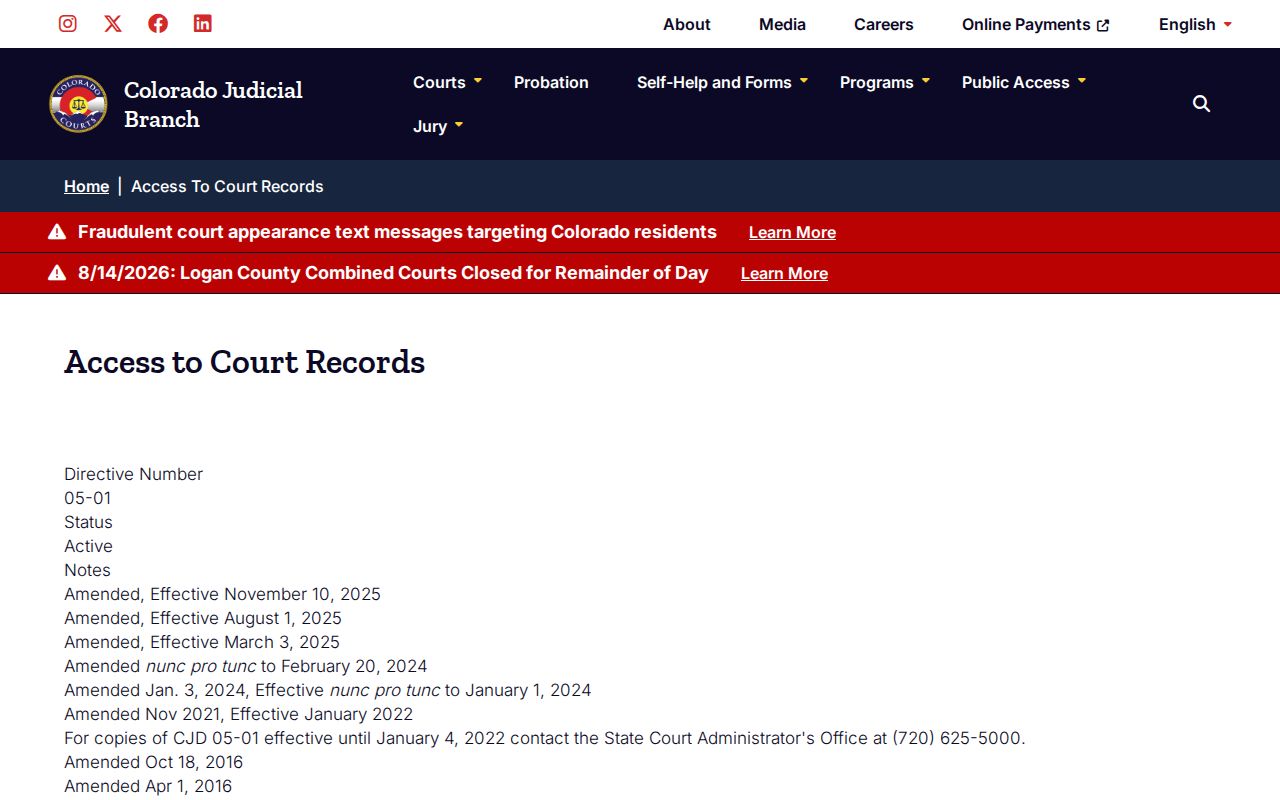
Go to the current directive page, since the access framework gained amendments through 2025.
The Colorado Open Records Act covers governmental records generally. Judicial case files run through the court directives instead. A broad county records request will not replace asking the Saguache Combined Court clerk for a case file.
Access Rules for Court Records
You can inspect and copy public court information. Sealed files are different; they need proper authority or a court order. Juvenile records may be confidential under Title 19. Protected identifiers can be withheld. So can judicial work product and confidential parts of probate or other matters. If access turns on your role, the clerk may ask for government photo identification.
Colorado access framework: CJD 05-01 governs court-record access; CJD 06-01 governs fees; Title 19 restricts specified juvenile material.
Online, a sealed entry may be missing or show only limited metadata. Court staff cannot lift a judicial restriction by administrative request, so a motion, petition, or court order may be needed.
Saguache Combined Court Clerk
501 4th Street
P.O. Box 197
Saguache, CO 81149
719-655-2522
SaguacheClerk@judicial.state.co.us
Weekdays, 8:00 a.m. to 4:00 p.m.
Court Files and DMV Files
The Colorado DMV motor-vehicle record source offers a useful boundary. It sits with a different custodian, and it shows why you must pin down the record type before making a request.
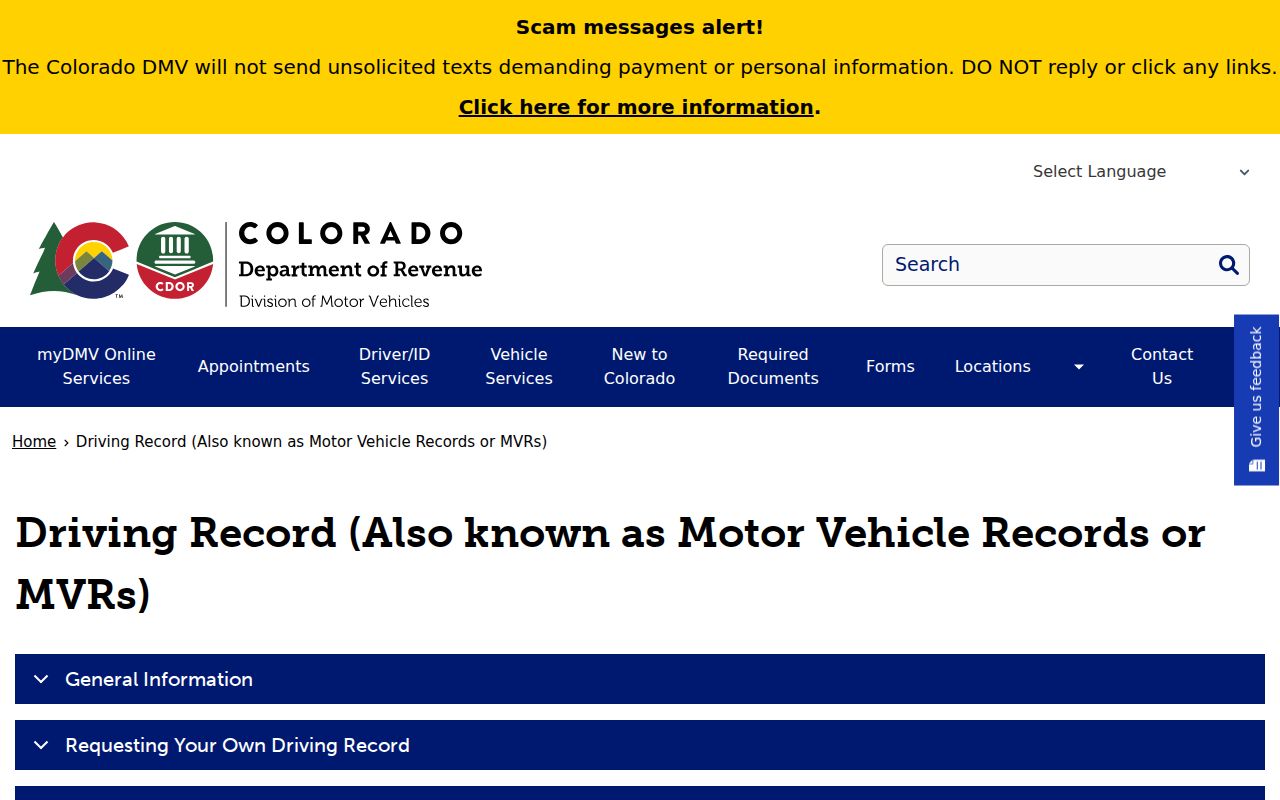
The DMV image is not a court file. It simply marks a boundary. State licensing records end there, and the judicial records kept by the Saguache court clerk begin.
Federal files add another layer. Saguache County sits in the federal District of Colorado and the Tenth Circuit. There, PACER and CM/ECF supply federal dockets. County geography alone never folds a federal record into the state Combined Court file.